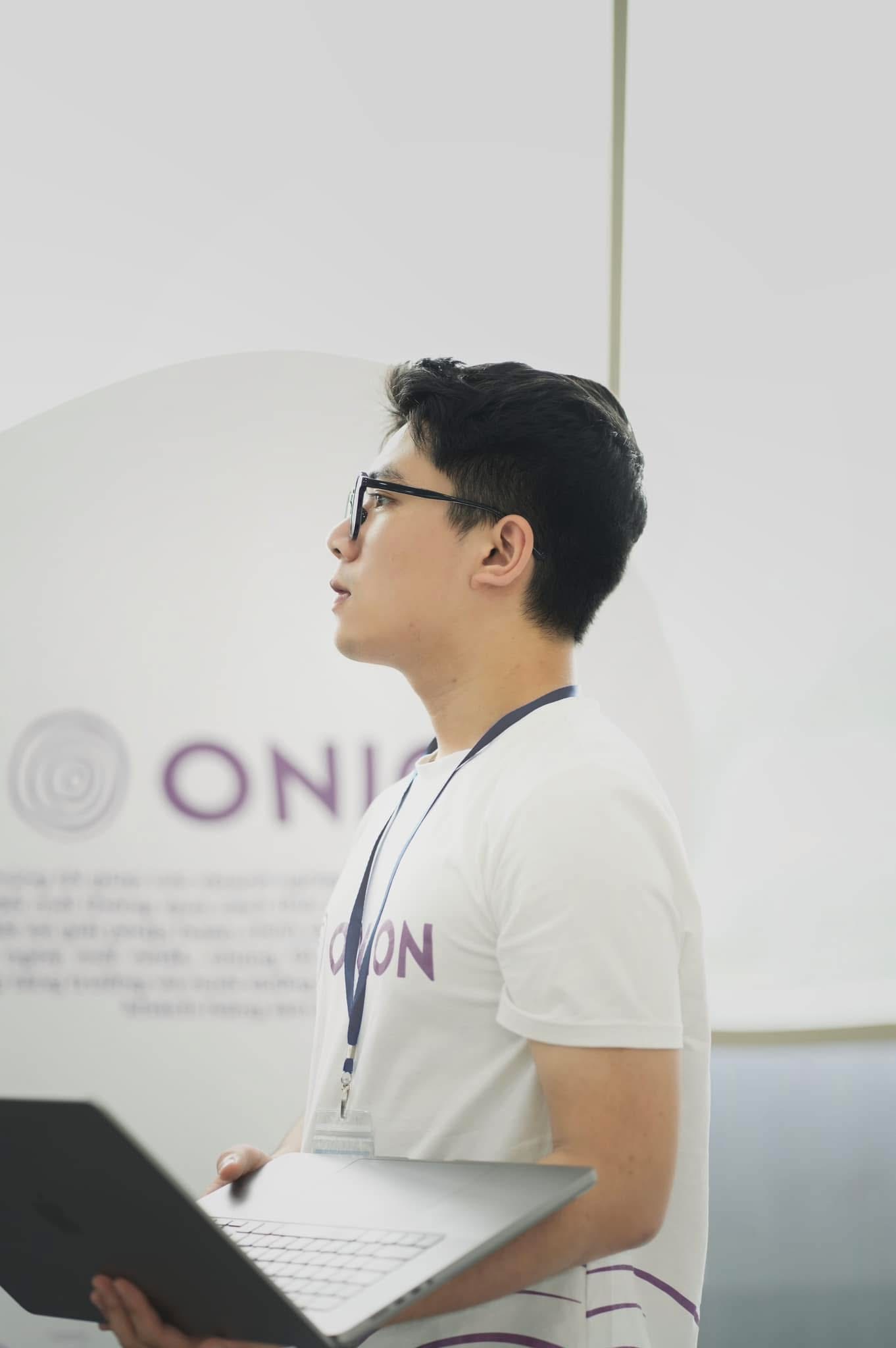
Bruce
Anh Nguyen Tran Quoc
Dream Builder
Anh Nguyen Tran Quoc
Dream Builder
Anby is the AI operating platform for your organization. It records and summarizes your meetings, syncs your Google Calendar, tracks your OKRs, and turns it all into shared knowledge your team can ask — so every decision rests on real context, not anxiety.
Connect your Google account to record and summarize Google Meet calls and sync your Google Calendar. We use this data only to deliver those features — see our Privacy Policy.
Core apps
All three are live today. God Brain is in Beta — early access available. Click a tab to switch between them.
OKRs that don't die in a spreadsheet. Every draft gets graded, every check-in compounds into context — so strategy stays alive from boardroom to Monday morning.
"Framework from Anby. Judgment from AI. Decisions from you."
Your organization's brain starts with every meeting. Auto-joins, transcribes, and routes every decision — so the whole team stays aligned without anyone hitting record.
"Meet once. Knowledge stays forever."Learn more
Not a filing cabinet. A coworker that remembers everything — and never quits. The patterns of your org meet the patterns of the world's most successful teams.
"Notion is a cabinet. Confluence is a warehouse. God Brain is the coworker who never forgets."
The pains we quiet
Hover each card to see how it plays out — and what Anby does about it.
FOUNDER OUT OF CENTER
Your team keeps walking to your desk: "What should we do here?" "Is this OK?" Anby learns your org from the inside — its decisions, its patterns, its context — so your team gets answers without going through you.
STRATEGY → MONDAY
Quarter starts with a beautiful strategy deck. Three weeks later, every team is back to their own checklist. Anby translates strategy into the priorities each team sees this week, this day, on this task — so the plan you committed to is the plan that runs.
EVIDENCE BEHIND EVERY CALL
You know the numbers are somewhere — runway, hiring pipeline, marketing ROI, churn. Anby reads across your org continuously and brings the right context to the moment you decide — with rationale, evidence, and patterns from teams who've been there.
Roadmap
Every Anby app we ship retires another piece of your scattered stack — and feeds into the same brain. The more apps you turn on, the deeper the context the next decision rests on.
9 apps on the way · shipped roughly quarterly
Strategy framework + True North for the whole org
Core metrics, confidence-based — no more dashboards that lie
AI that understands your entire org — Q&A, intel, custom prompts
50+ AI agents that actually do work, not just suggest
Onboarding framework for new processes, with peer feedback + synthesis
Org structure, profiles, package access
Multi-entity finance, accountant flow, Sheets sync
Recognition culture, badges, missed-reminders
Monthly department recaps, compound memory
Platform vs. stack
Every SaaS you stack on adds another silo — another login, another data island, another audit gap. Anby replaces the stack with a platform.
"Which accounts did Sales miss last quarter, and why?"
One-sentence answer with evidence links to the exact deals discussed, the targets missed, and the decisions made. The same question across 12 SaaS? A week of spreadsheet forensics.
Platform, not just apps
Anby is a platform — not a closed app suite. If your org has a bespoke process that no tool on the market fits, build it on Anby and it joins the same brain as the rest. Two paths, depending on who you have on the team.
React + Anby SDK, deployed as a sub-app in your workspace. Full control, auth inherited, full data access. No-code and low-code builders aren't supported yet — full-code is the one path today.
Don't have engineers, or want it shipped fast? Contact us with the module spec — we'll scope, quote, and implement. The app lives inside your workspace, accessible only to your organization.
Every app you build gets this — free
Every Anby-native app — built by us or by you — inherits the same platform primitives. No reinventing auth, no rebuilding integrations, no glue code.
Need a custom module? The Anby team can scope and build it for you. Contact us for module-level pricing — everything stays internal to your org.
Book a build-it consultationWho it's for
If you're on the fence, read both columns. We'd rather tell you "not yet" than over-promise.
Anby fits you if
Your org runs on memory and personal heroics
Whenever someone leaves, knowledge walks out. Whenever the founder takes a week off, decisions stop.
Field note · memory riskStrategy and Monday morning feel like different planets
Your quarterly plan and your team's actual to-do list have drifted apart — and you keep pulling them back together by hand.
Field note · Monday driftYou decide by gut while data lives in 12 dashboards
You know the numbers are somewhere. Pulling them together for one decision still takes a day.
Field note · decision latencyYou've tried Notion + dashboards + meetings — still scattered
You don't need another tool to maintain. You need fewer, smarter ones that share context.
Field note · tool fatigueAnby isn't for you if
You're a solo founder or single-seat user
Anby is built for organizations thinking together, not personal productivity. Try a personal AI assistant instead.
Your problems are individual, not organizational
If you need a better way to write email or summarize a doc, you'll find that elsewhere.
You'd rather build your own AI stack
If you have engineers and can wire Claude + Postgres + your data together, you're better off self-building.
You can't commit past one quarter
Anby compounds: meeting → OKR → knowledge. One quarter doesn't show the value.
What we believe
Every app Anby ships follows these four principles. They're not marketing language — they're the decisions we make every time a feature is scoped.
We measure ourselves by whether you make fewer, better decisions — not by how many tasks we automate. Fewer calls, calmer org.
Anby learns from your meetings, your OKRs, your decisions, your context. Every answer is your answer — not what a generic AI would say.
We bring patterns from the world's most successful teams to your decision-making — anonymously, ethically. Your org meets the best practices of every org.
Every meeting feeds OKRs. Every OKR feeds God Brain. Every decision feeds the next one. The longer you run on Anby, the more it understands.
As your org grows with Anby, you don't just get more features — you gain operating capabilities your old org didn't have.
Pricing
Per-workspace, flat — never per seat. Start free, upgrade only when Anby is running your operating stack.
Solo founders, pilots, or teams trying things out
Teams making Anby their daily operating driver
Orgs where AI is core to how the team operates
Large customers, design partners, strategic needs
Our Story
The story behind Anby — why we believe the next shift in organizations is not about adopting AI, but redesigning the system around it.
There are moments when an organization does not break, but begins to drift. No alarms go off. No dramatic collapse happens overnight. Everything appears intact on the surface — meetings still take place, plans are still written, people are still busy. Yet underneath, something essential has already started to erode.
Clarity fades first. Then meaning.
Work continues, but no one can clearly explain why it matters. Decisions are made, but they no longer feel sharp. The system still moves, but its direction becomes uncertain. This is the kind of crisis that rarely gets named, because it does not look like failure — it feels more like a quiet loss of alignment between effort and outcome.
For a long time, many organizations try to solve this by doing more. More meetings. More reports. More pressure. More control. But effort, when placed on top of a flawed system, does not create strength. It accelerates fatigue.
Then AI arrived — not as a solution, but as a disruption.
It did not simply offer new tools. It exposed an uncomfortable truth: much of what organizations had accepted as "normal work" was never necessary in the first place. Layers of coordination, repetition, and manual thinking suddenly became visible as inefficiencies. And with that visibility came a difficult question — if machines can now handle parts of this, what should humans really be doing?
Some organizations reacted by experimenting at the edges. A tool here, a pilot project there. But these attempts often remained superficial, because they did not address the core issue. The problem was never the absence of tools. It was the absence of a system designed to integrate them meaningfully.
The real shift begins only when an organization stops asking "How can we use AI?" and starts asking "What should our system look like if AI is already part of it?"
That shift is not about speed. It is about structure.
It requires rethinking how decisions are made, how information flows, and where human attention is truly valuable. It means removing work that exists only because it always has, and redesigning processes so that machines carry what they are better suited for — leaving humans with the parts that require judgment, creativity, and responsibility.
This is not an easy transition. It demands honesty. It requires letting go of familiar ways of operating, even when they feel safe. And often, it only happens after an organization has gone through enough pressure to realize that the old system can no longer sustain itself.
From that realization, a different kind of approach begins to emerge. Instead of adding more layers, the focus shifts to building a foundation — a system where AI is not an add-on, but part of the operational core. A system that can observe, suggest, and support decisions continuously, not occasionally. A system that reduces noise instead of adding to it.
That is the space where Anby exists.
Not as a collection of tools, but as an attempt to redesign how organizations operate in a world where intelligence is no longer limited to humans alone. Its purpose is not to replace people, nor to automate everything. It is to help organizations regain clarity — to see what matters, remove what does not, and operate with a level of precision that was previously difficult to sustain.
Because in the end, the challenge is not about adopting technology. It is about confronting reality.
And when an organization is willing to do that — to see clearly, to redesign deliberately, and to act with discipline — AI stops being a threat.
It becomes a form of liberation.
Not from work itself, but from the inefficiencies and illusions that have quietly shaped how work has been done for far too long.